

Article summary
- Legal Process Outsourcing (LPO) in 2026 has evolved from a cost-cutting tactic into a strategic partnership that enhances efficiency, agility, and legal expertise.
- Modern LPO integrates AI and human expertise, enabling faster turnaround, higher accuracy, and scalable legal operations.
- Law firms and corporations use LPO to reduce costs (30–80%), access specialized talent, and focus internal teams on high-value legal work.
- A hybrid onshore–offshore model is increasingly common, balancing data security and compliance with global scalability and 24/7 productivity.
- The future of LPO emphasizes specialization, AI-driven workflows, and integrated cloud platforms, positioning firms for sustainable growth and competitiveness.
In the high-stakes legal arena of 2026, the winning formula is no longer just about billable hours and precedent. It’s about agility, strategic foresight, and technological prowess. Legal Process Outsourcing (LPO) has shed its outdated reputation as a mere cost-cutting lever to emerge as the cornerstone of a modern, competitive legal practice. For forward-thinking firms and corporate legal departments, it is the strategic partnership that unlocks unprecedented efficiency, expertise, and growth.
What is Legal Process Outsourcing? The 2026 Definition
Legal Process Outsourcing (LPO) is a strategic business practice where law firms, in-house legal departments, and corporate teams delegate specific legal tasks or entire processes to external service providers. As of 2026, LPO has evolved from a simple cost-cutting tactic into a high-value partnership model that integrates advanced technology like Generative AI to enhance accuracy and service delivery.
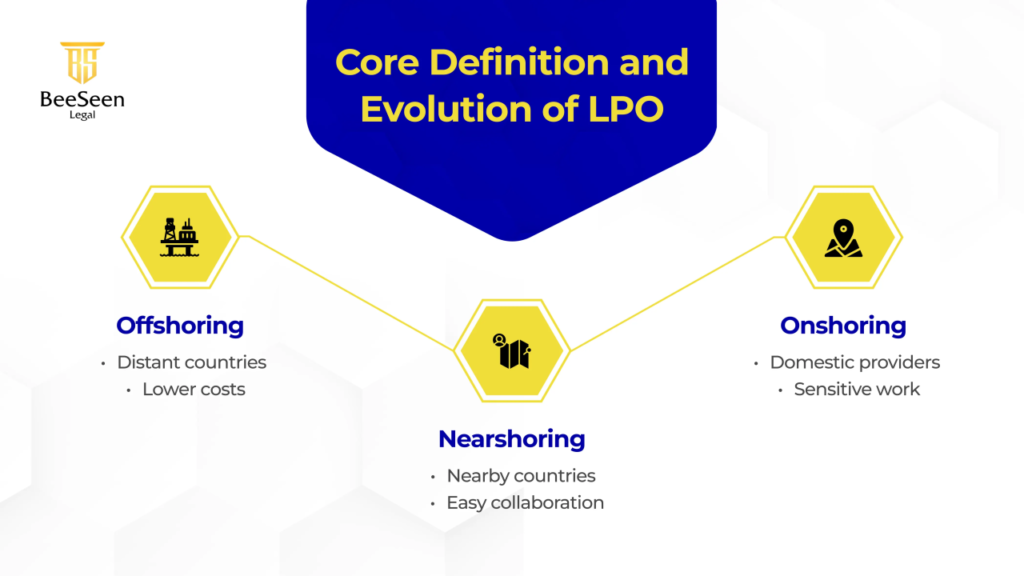
Core Definition and Evolution of LPO
At its core, LPO involves obtaining legal support services from an outside source rather than relying solely on internal staff. This practice typically follows three main geographical models:
- Offshoring: Outsourcing tasks to providers in different countries, often with significant cost differences, such as India or the Philippines.
- Nearshoring: Delegating work to closer countries within similar time zones to facilitate real-time collaboration.
- Onshoring: Hiring local external agencies or professionals within the same country, often preferred for sensitive tasks requiring strict data security compliance.
In 2026, the industry is increasingly defined by Knowledge Process Outsourcing (KPO) standards, prioritizing specialized domain expertise over high-volume administrative “grunt work”.
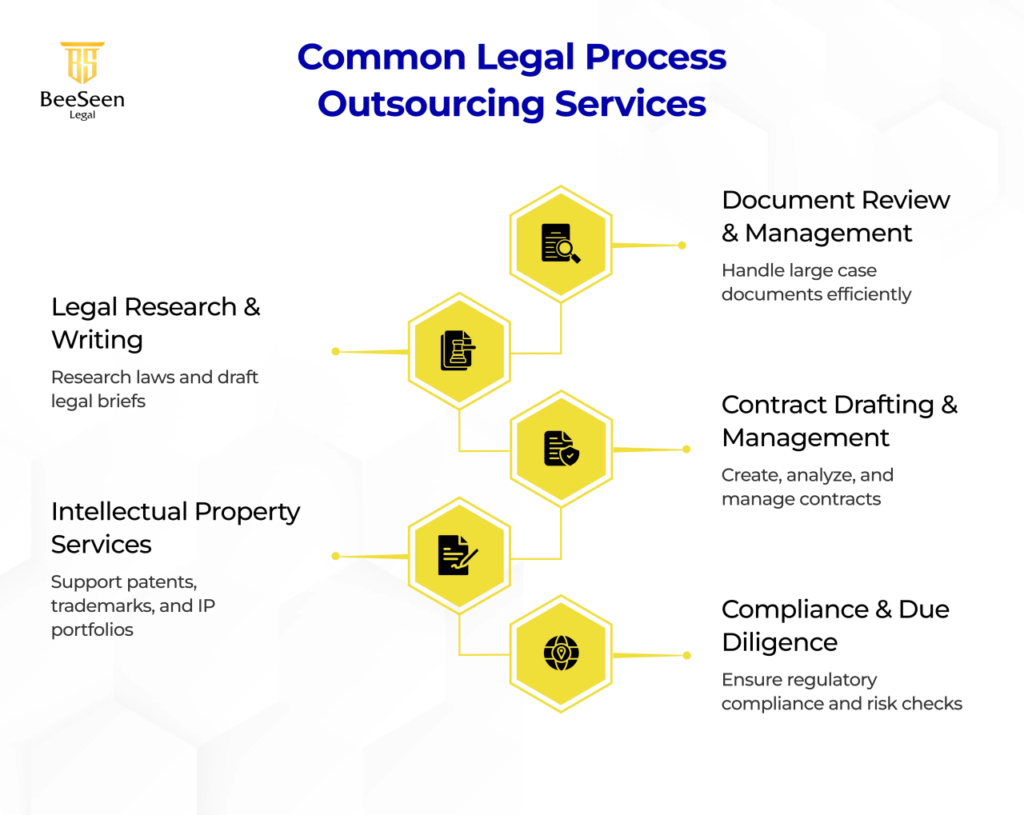
Common LPO Services
LPO covers a wide range of legal support services, including:
Document Review and Management
This is one of the most common LPO services, especially in litigation and e-discovery. Tasks include:
- Reviewing documents for relevance and privilege
- Coding and summarizing legal documents
- Managing large volumes of case files
Legal Research and Writing
LPO providers assist with:
- Case law research
- Statutory and regulatory analysis
- Drafting legal memos, briefs, and opinions
Contract Drafting and Management
Services often include:
- Drafting standard contracts and agreements
- Contract abstraction and analysis
- Contract lifecycle management
Intellectual Property (IP) Services
LPOs play a major role in IP support, such as:
- Patent and trademark searches
- Patent drafting and prosecution support
- IP portfolio management
Compliance and Due Diligence
These services are particularly valuable for corporations and law firms handling transactions:
- Regulatory compliance checks
- M&A due diligence
- Risk assessment and reporting
Why Do Law Firms and Corporations Use LPO Services?
The growing adoption of Legal Process Outsourcing is driven by several compelling benefits.
Cost Efficiency
One of the biggest advantages of LPO is reduced operational cost. Outsourcing routine legal work can cut expenses by 30–70% compared to handling the same tasks in-house or through traditional law firms.
Focus on Core Legal Work
By outsourcing repetitive and time-consuming tasks, lawyers can focus on higher-value activities such as client counseling, strategy, negotiations, and litigation.
Access to Skilled Legal Talent
Many LPO providers employ qualified lawyers, paralegals, and legal professionals with specialized expertise across jurisdictions and practice areas.
Scalability and Flexibility
LPO allows organizations to scale resources up or down based on workload without the long-term commitment of hiring full-time staff.
Faster Turnaround Times
With dedicated teams and optimized workflows, LPO providers often deliver work more quickly, especially when operating across different time zones.
Onshore vs Offshore Legal Process Outsourcing in 2026
In 2026, the choice between Onshore and Offshore Legal Process Outsourcing (LPO) depends on balancing regulatory security with cost efficiency. Many modern firms adopt a hybrid model, keeping sensitive, client-facing tasks onshore while moving high-volume processing offshore.
Comparison Overview
| Feature | Onshore LPO | Offshore LPO |
| Location | Within the same country. | Geographically distant country. |
| Cost Savings | Minimal; Operational rates match local standards. | 60–70% reduction in operational costs. |
| Time Zone | Same/aligned; real-time collaboration. | Different; enables 24/7 productivity. |
| Compliance | Simpler; governed by identical laws. | Complex; requires cross-border legal vetting. |
| Talent Pool | Limited to domestic availability. | Access to a vast global talent market. |
Onshore Legal Process Outsourcing
Onshore LPO involves delegating tasks to a provider within the same country (e.g., a New York firm using a team in Texas).
- Best For: Highly regulated work, mission-critical initiatives, and tasks requiring frequent in-person or real-time collaboration.
- Key Advantage: Direct understanding of jurisdiction-specific standards and immediate alignment with changing local requirements.
- Main Drawback: Significantly higher costs due to domestic wage standards.
Offshore Legal Process Outsourcing
Offshore LPO assigns tasks to teams in different countries, typically with lower operational costs.
- Best For: High-volume, execution-heavy tasks like document review, contract abstraction, and data entry.
- Key Advantage: Extreme scalability and 24/7 operation cycles, allowing work to continue while the local firm is closed.
- Main Drawback: Communication barriers, cultural gaps, and increased concerns regarding client confidentiality and data privacy (e.g., GDPR/HIPAA).
Key LPO Services Landscape
Modern LPO providers handle a vast spectrum of tasks, ranging from routine administrative support to highly complex legal analysis.
| Service Category | Common Examples |
| Litigation Support | E-discovery, document review, and deposition summaries. |
| Contract Management | Drafting standard agreements, review, and lifecycle management (CLM). |
| Intellectual Property | Patent research, trademark monitoring, and filing assistance. |
| Compliance & Regulatory | Monitoring regulatory changes, ESG reporting, and data privacy audits. |
| Legal Research | Case law analysis, drafting memos, and market research. |
Strategic Benefits of Outsourced Legal Services for 2026
- Cost Efficiency: Organizations can save between 30% and 80% on operational expenses by leveraging labour arbitrage in developing regions.
- AI-Enhanced Productivity: Leading providers now use AI-driven tools for predictive analytics and automated document classification, significantly reducing turnaround times.
- Scalability: LPO allows firms to build “on-demand” virtual teams, enabling them to take on large, complex cases without the permanent overhead of new hires.
- 24/7 Global Cycles: Exploiting time zone differences allows projects sent from Western markets at the end of the day to be completed by the next morning in hubs like India.
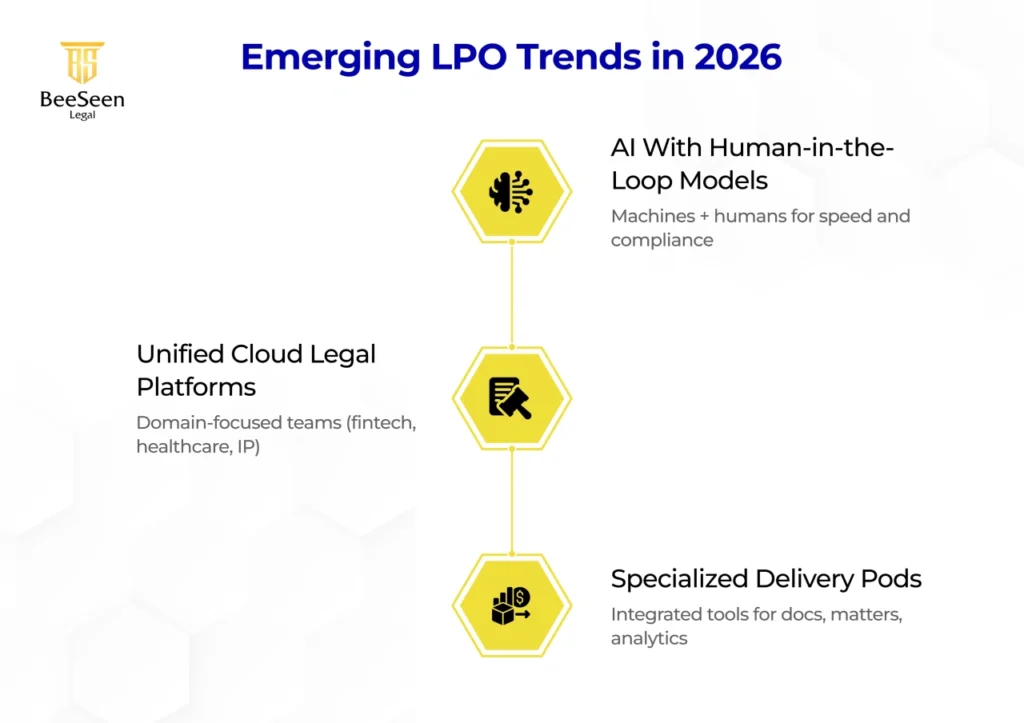
Emerging LPO Trends in 2026
- AI with Human-in-the-Loop: Purely automated results are being replaced by hybrid models where AI handles high-speed sorting and qualified human experts perform the final nuanced review.
- Specialization over Generalization: Clients are moving away from broad generalists toward specialized “pods” with deep expertise in niche areas like fintech compliance or environmental law.
- Unified Cloud Environments: Fragmented legal tech is giving way to integrated platforms that centralize document automation, matter management, and spend analytics.
Next Steps for Your Law Firm
Ready to explore how LPO can become a pillar of your firm’s success in 2026?
BeeSeen Legal offers end-to-end LPO solutions tailored to your firm’s needs—from AI-enhanced litigation support to specialized compliance pods and secure legal IT outsourcing.
Schedule a free LPO strategy consultation to see how we can help you build a more agile, profitable, and future-ready practice. Contact BeeSeen Legal Today
Frequently Asked Questions
Legal Process Outsourcing (LPO) is the practice of delegating legal tasks or entire legal processes to external service providers. In 2026, LPO goes beyond cost savings and includes AI-driven legal support, specialized expertise, and scalable legal operations for law firms and corporations.
LPO services include document review, legal research and writing, contract drafting and management, intellectual property services, litigation support, compliance monitoring, and due diligence for mergers and acquisitions.
LPO works by assigning defined legal tasks to a third-party provider under strict confidentiality and compliance standards. The provider uses legal professionals and technology platforms to deliver work efficiently while the client maintains oversight and control.
Law firms use LPO to reduce costs, improve turnaround times, access specialized legal talent, and focus internal teams on higher-value legal strategy and client advisory work.
Yes, reputable LPO providers follow strict data security protocols, including ISO certifications, GDPR compliance, SOC 2 standards, and secure cloud environments to ensure client confidentiality and data protection.
Onshore LPO uses providers within the same country, offering easier compliance and real-time collaboration at higher costs. Offshore LPO uses providers in other countries, delivering significant cost savings and 24/7 productivity but requiring stronger governance and security controls.
Organizations typically save between 30% and 70%, and in some cases up to 80%, compared to handling the same legal work in-house or through traditional law firms.
No, LPO does not replace lawyers. It supports them by handling time-intensive and process-driven tasks, allowing lawyers to focus on complex legal analysis, advocacy, negotiations, and client relationships.
In 2026, AI enhances LPO through automated document review, contract analysis, predictive analytics, and e-discovery. Most providers use AI with human-in-the-loop models, ensuring accuracy, legal judgment, and ethical oversight.
Industries such as banking, fintech, healthcare, technology, real estate, and manufacturing benefit significantly from LPO due to high regulatory demands, contract volumes, and compliance requirements.
Key factors include legal expertise, data security standards, technology capabilities, industry specialization, scalability, communication transparency, and experience with your jurisdiction and regulatory environment.
Yes, LPO is highly beneficial for small and mid-sized law firms because it provides enterprise-level legal support, flexible staffing, and advanced technology without the cost of full-time hires.
The future of LPO lies in AI-enabled legal ecosystems, specialized legal pods, integrated cloud platforms, and strategic partnerships that help firms operate as agile, global, and data-driven legal organizations.
Key Points